What Is a Verified Career Identity and Why Every Professional Needs One in 2026
A verified career identity is essential in professional hiring. Learn what it means, how it works, why it matters and how to build one that recruiters actually trust.
June 19, 2026


You have spent years building your career. Every job. Every project. Every promotion. Every late night that led to a result your manager actually noticed. And when it is time to show all of that to a new employer, you put it in a Word document, format it nicely and hope someone reads it in the 6 or 7 seconds they have allocated to your resume.
That is the system most professionals are still relying on in 2026. And it is broken. This is where verified career identity comes in. This blog will tell you everything you need to know, what it is, how it works, why it matters and how to build one that genuinely opens doors.
What Is a Verified Career Identity?
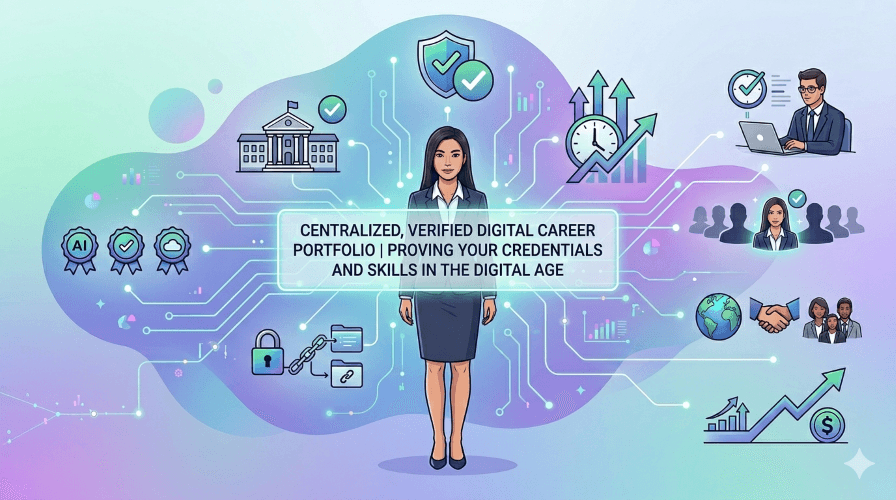
A verified career identity is a professionally authenticated profile where every significant claim about your career like your job titles, your employers, your tenure, your responsibilities and your performance has been independently confirmed by someone other than you.
Think of it this way. When you apply for a bank loan, the bank asks for salary slips, bank statements and employer letters. Verified documents. Because proof carries weight that self-declaration does not.
Your career deserves the same standard.
A verified career identity takes everything you have done professionally and attaches external confirmation to it, from the employers who can vouch for your work.
Why Does Verified Career Identity Matter in 2026?
It is a fact that resumes contain discrepancies, ranging from exaggerated job titles to listing fake experience and credentials. Employment fraud is found across all levels: executives, managers and even senior leaders have been caught misrepresenting their credentials.
Hence, the hiring ecosystem is built on suspicion. Recruiters do not fully trust resumes. Candidates feel they have to exaggerate just to compete. And companies keep making expensive hiring mistakes because they have no reliable way to separate honest candidates from dishonest ones.
The Cost of Getting It Wrong
A bad hire is not just inconvenient. It is expensive leading to lost productivity, re-hiring costs, training time and the toll on team morale. Verified professionals are an asset for a company as all these expenses can be eliminated when a credible candidate is hired.
Recruiters Are Running Out of Time to Verify
Here is something most candidates do not think about.
A recruiter reviewing 200 applications for a single role has approximately 7 seconds to scan each resume before deciding to move forward or skip. Seven seconds. There is no time for deep analysis, cross-referencing or even a quick Google search.
In that window, a recruiter looks for signals of trust. And an unverified resume, no matter how well formatted, gives them no reason to trust or shortlist a profile. A verified profile can change the dynamics. Because they can read a professional identity that has been authenticated. The trust is already there. The decision becomes easier. And you get hired faster.
Verified Career Identity vs Traditional Resume
It helps to see the difference laid out directly.
Resume
- Written entirely by the candidate
- No external confirmation of any claim
- Static document does not update with new information
- Cannot be verified without time-consuming background checks
- Looks the same whether the candidate is honest or not
- Relies entirely on the recruiter trusting the candidate's word
Verified Career Identity
- Built collaboratively between the candidate and their employers
- Every significant claim is confirmed by an external party
- Live profile that evolves with your career
- Verification is already complete before the recruiter sees it
- Clearly distinguishes honest professionals from those who exaggerate
- Recruiter trust is established before the first conversation
The difference is structural. Because the recruiter finds a candidate who has already proven they deserve to be.
Verified Career Identity Reviews: Why Employer Ratings Change the Game
One of the most underrated aspects of a verified career identity is what happens when past employers leave reviews and ratings on your profile.
Think about how you make decisions as a consumer.
Before booking a hotel, you check reviews. Before downloading an app, you check ratings. Before hiring a contractor, you ask for references. You do this because third-party opinions carry far more weight than self-promotion. Hiring works the same way.
What Employer Reviews Actually Tell a Recruiter
When a past employer rates and reviews your profile, they are doing something a resume cannot, they are giving you a verified identity. A recruiter who sees that a profile has good reviews from past employers need not wonder whether you are as good as you say. The people who actually managed you have already answered that question.
How Reviews Build Long-Term Professional Credibility
Verified career identity reviews are not just useful for your next job. They are a long-term professional asset.
Each new role, each new employer confirmation and each new review adds to a cumulative professional record that tells your story more accurately than any document you could write yourself.
Verified Career Identity Examples: What It Looks Like Across Different Profiles
-
The Experienced Professional
Sandeep has eight years of experience across three companies in the BFSI sector. On his verified career identity profile, all three employers have confirmed his designations, tenures and responsibilities. When a recruiter opens his profile, there is nothing to question. Everything is already confirmed.
-
The Professional With a Career Gap
Meera took nine months off to care for her parents. On a traditional resume, this gap would raise flags. On her verified profile, her two previous employers have confirmed her full work history with strong ratings. The gap is visible, but the verified context on either side of it removes the ambiguity. Recruiters see a complete, honest story.
-
The Fresher
Arjun is a fresh graduate with one internship. His resume looks thin. But his internship manager has verified his role on Collar Check, confirmed his contribution and given him a star rating. That single verified endorsement carries more credibility than any self-written summary.
-
The Career Switcher
Divya is moving from marketing to product management. Her skills are transferable but her title history does not directly reflect her new direction. Her verified career identity shows employer-confirmed responsibilities that demonstrate her analytical work, her cross-functional projects and her stakeholder management; all verified by the people she worked with.
How to Build Your Verified Career Identity
Building a verified career identity is simpler than most people think. Here is a practical step-by-step approach.
Step 1: Choose the Right Platform
Not all job platforms offer genuine verified career identity. Collar Check is World’s first platform built specifically with a structured four-level verification system, employer ratings and a unique CC ID that acts as a professional identity you carry across every job.
Step 2: Build Your Profile Accurately
Accuracy is the foundation. Add every role with honest titles, correct dates and genuine responsibilities. Start with verifying your official work email to establish your basic professional identity on the platform.
Request Employer Verification by reaching out to past employers and request them to verify your employment on the platform.
Most importantly, keep it updated. Every time you change jobs, add the new role, request verification from your new employer and continue building your professional record. Over time, verified career identity reviews become one of the most credible representations of your career in existence.
Conclusion
In 2026, the question is no longer whether you have the experience. The question is whether you can prove it. A verified career identity is the answer to that question. It takes the work you have genuinely done, the roles you have honestly held and the performance you have actually delivered and backs all of it with external confirmation that a recruiter can trust immediately.
It is not about gaming the system. It is about letting the system finally work in favour of honest professionals. Verified career identity is the new trust currency today.
Frequently Asked Questions
Q1. What exactly is a verified career identity?
It is a professionally authenticated profile where your employment history, job titles, tenure, responsibilities and performance have been confirmed by your past or current employers, not just self-reported by you.
Q2. How is a verified career identity different from profiles on other portals?
Profiles on other portals are self-managed and self-reported. Anyone can write anything on it with no external confirmation. A verified career identity, on the other hand, requires employer confirmation of your roles, tenure and responsibilities along with star ratings and reviews from past employers. The key difference is accountability.
Q 3. How do verified career identity reviews work and why do they matter?
Verified career identity reviews are star ratings and written feedback left by past employers directly on your professional profile. They work similarly to product or service reviews, giving recruiters an independent, third-party perspective on your actual performance.
Q. 4. How do I get started with building a verified career identity in India?
The easiest way to get started is to sign up on Collar Check, the world's first professional identity verification platform. It is free for all job seekers. You create your profile, add your work history accurately, get it verified from past managers. You get a unique CC ID, which acts like Aadhar of your professional career.
Related Blogs

AI Is Reading Your Resume Before a Recruiter Does. But Why?

How to Hire Software Engineers for a Startup in India?
Top Recruitment Platforms for Tech Startups in 2026

Best Job Search Sites in India That Actually Get You Hired in 2026