Resume Gaps, Fake Roles, Inflated Titles: The Hiring Blind Spot!
Are fake resumes impacting your hiring process? Discover how resume gaps, inflated job titles and fake roles are costing Indian companies and how Collar Check's verified hiring platform is fixing it.
April 3, 2026


When was the last time you fully trusted a resume?
If you're a hiring manager or recruiter in India, that question probably hit differently. Resumes are written in flowery language with inflated professional adjectives and somewhere in between, the truth hits hard: resumes are broken leading to massive hiring blind spots.
We're talking about candidates who list roles they never held, use inflated job titles from "Executive" to "Manager" or "Manager" to "Director," and explain away six-month resume gaps with vague lines like "pursued personal development" or "freelance consulting." And honestly? Most of us have seen it or been fooled by it.
So let's dig into why this keeps happening, why it matters more than most companies realise and what verified hiring platforms like Collar Check are doing to finally close this gap.
Why Fake Resumes Are More Common Than You Think
Here's a stat that should make any recruiter uncomfortable: studies consistently show that a significant portion of job applicants misrepresent something on their resume. It could be a stretched employment date, a title that was one level above their actual role or a "team lead" who led a team of exactly one person, themselves.
The motivation is simple. In a competitive job market, candidates feel pressure to stand out. And when there's no real system for fake resume detection, why not nudge the truth a little?
Resume fraud in India is everywhere. It's quietly becoming a norm. The result? Companies spend weeks interviewing candidates who look great on paper, extend offers based on inflated job titles and then spend months dealing with the fallout leading to underperformance, culture mismatch or worse, a fraudulent hire in a sensitive role.
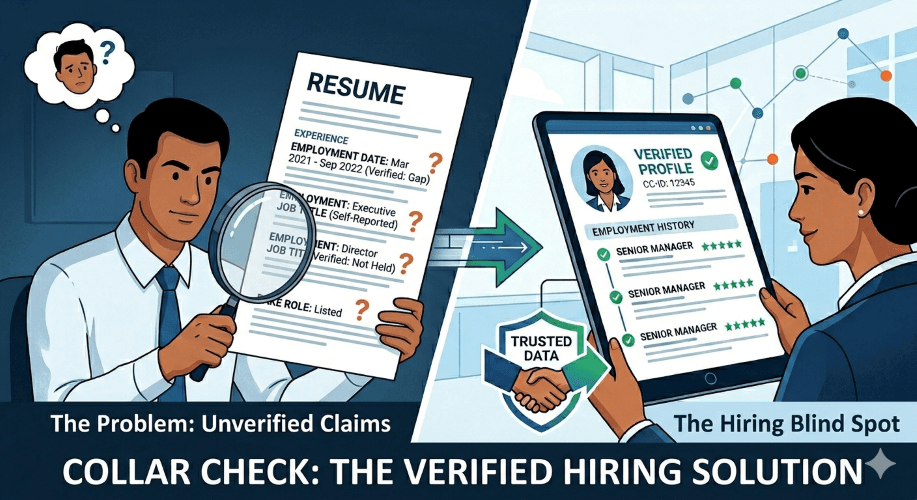
This is what we call the hiring blind spot, the space between what's on the resume and what's actually true.
Resume Gaps: The Real Story
Resume gaps are perhaps the most misunderstood part of the hiring conversation. A candidate who took eight months off, whether due to family obligations, health, job loss or genuine exploration often feels compelled to hide it or fabricate filler experience just to avoid awkward questions.
And recruiters, for their part, often penalise gaps without asking the right questions first.
The truth is, a gap on a resume tells you very little on its own. What matters is what came before it, how the candidate performed and what kind of employer reviews they carry. That's the kind of context that a traditional CV simply cannot provide, but a verified employment history can.
When Collar Check verifies a professional's complete work journey, gaps become part of an honest, transparent story, not a resume red flag to be ashamed of or a blank to be filled with lies.
Inflated Titles: Small Lie, Big Problem
"Senior" this. "Head of" that. "Lead" everything.
Inflated job titles are rampant and cost companies in ways that are hard to measure immediately but very painful over time. When someone claims a senior role without the actual experience that comes with it, you end up with a new hire who can't make decisions independently, struggles to manage people or lacks the domain depth their title suggests.
What makes this particularly tricky is that job titles vary wildly across companies. A "Senior Associate" at a startup might be a fresh graduate. A "VP" at a small firm might do the work of an analyst at a larger one.
Without a way to contextualise roles within the actual company and get employer-verified feedback, titles are almost meaningless.
This is exactly the problem Collar Check was built to solve. Through its CC Pro Profile, verified work histories show not just where someone worked but their actual responsibilities, cross-checked and rated by past employers. The CC ID acts like a professional passport: portable, trusted and real.
The Cost of Getting It Wrong
Bad hires are expensive. A wrong hire leads to lost productivity, training costs, recruitment rounds and the time a team loses managing underperformance.
And yet, most companies still rely on self-reported CVs and two to three reference calls as their primary verification method. Reference calls, where the candidate provides the contacts. It's almost comical when you say it out loud.
The traditional background verification industry does exist, but it's slow, expensive and often done after the offer is extended, by which point the company has already professionally committed to the candidate.
How to Detect a Fake Resume
Knowing how to detect a fake resume starts with spotting the patterns:
- Vague job descriptions with no real metrics
- Timelines that don't add up
- Inflated job titles that don't match the responsibilities being described.
Resume fraud in India often hides in plain sight: a "Regional Head" describing tasks of a field executive, a "Team Lead" with zero reportees or employment dates that shift between versions.
How Collar Check is Eliminating Fake Roles, Resume Gaps and Inflated Titles?
CollarCheck is the world's first verified hiring platform and it's built specifically to tackle resume fraud in India head-on. Here's what makes it different from your standard job board:
- Verified profiles, not self-reported ones.
Candidates on Collar Check can build their verified profiles by requesting their past or current employers to verify their employment history, rate and review their performance. This means by the time a recruiter looks at a profile, they're seeing data that's been cross-checked, not just typed in by the candidate.
- The CC ID.
Think of it as an Aadhaar for your career. Every professional on Collar Check gets a unique, verified identity that travels with them across jobs. It's not editable without employer confirmation. It's the truth, on record making resume fraud in India significantly harder to pull off.
- Star ratings from past employers.
Not unlike how you'd check reviews before booking a hotel, Collar Check lets employers see how a candidate actually performed, not just what they claim about themselves.
- Immediate transparency.
With over 15 lakh verified professionals and 1 lakh+ companies already on the platform, recruiters can access pre-validated profiles and reduce background check time dramatically.
For job seekers, it's equally powerful. Your verified profile does the talking before you even walk into an interview. For companies serious about hiring right the first time, Collar Check is quickly becoming the go-to.
Conclusion
The days of trusting a shiny PDF and a charming interview should be behind us. In 2026 and beyond, hiring needs to be built on verified data, transparent histories and real employer feedback, not polished self-promotion.
Resume gaps shouldn't be mysteries. Job titles should mean something. And fake roles should have nowhere to hide.
Resume fraud in India is a problem that's only going to grow if the industry doesn't adopt smarter, verified systems. If you're a recruiter tired of being burned by inflated resumes, or a professional who wants your real work to finally speak for itself, it's time to join the verified hiring movement. It’s time to join Collar Check.
FAQs
Q.1. What is an inflated job title on a resume?
Ans: An inflated job title is when a candidate exaggerates or misrepresents their actual designation, like calling themselves a "Manager" when they were an Executive, or a "Team Lead" with no one reporting to them. With Collar Check's employer-verified profiles, inflated titles have nowhere to hide.
Q.2. What to put on a resume for gaps in employment?
Ans: Follow these pointers
- Be honest.
- Briefly mention freelance work, upskilling, caregiving or health recovery, whatever genuinely fills that period.
- With Collar Check's verified employment history, gaps are presented transparently with full context, so you never have to hide or fabricate anything to impress recruiters.
Q.3. What is a red flag on a resume?
Ans: Red flags on a resume are
- Dishonesty or inconsistency
- Unexplained gaps
- Frequent job-hopping
- Fake and vague job titles
- Missing employer details
- Responsibilities that don't match the role claimed.
But Collar Check has a solution for this, with employer-verified profiles and star ratings, recruiters can instantly spot what's real and what's not.
Q.4. Can I get a job after a 2 year gap?
Ans: Yes, a 2 year gap is not a disqualification. What you need is the right way of portraying it. Whether you were upskilling, caregiving, freelancing or dealing with personal circumstances, what matters is how you present it. Collar Check helps you build a verified, transparent profile that lets your real work history speak for itself, gap and all.
Related Blogs

AI Is Reading Your Resume Before a Recruiter Does. But Why?

How to Hire Software Engineers for a Startup in India?

Top Recruitment Platforms for Tech Startups in 2026

Best Job Search Sites in India That Actually Get You Hired in 2026