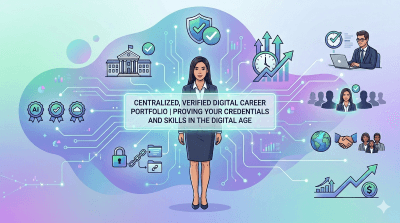
How to Write a Resume That Gets You Hired Faster in India?
Resume writing continues to be one of the most searched career topics online. This blog will teach how to write a resume that works in 2026 and why building a verified professional profile matters most in today's hiring landscape.

March 27, 2026


How to Make Your Resume Work for You
You devote time to writing your resume, picking the right font, listing every achievement and making it fit for the job before hitting the "apply" button. But, what follows is highly demotivating because you do not get a reply or a call. This situation is relatable for several applicants.
Here's a reality check:
Most job seekers are not writing the resume wrong, but still are not getting shortlisted or hearing back. Their resume isn't bad. The fact is that a resume alone is not enough to get you hired in 2026.
This blog will walk you through how to write a strong resume and more importantly, what you need to do beyond the resume to actually land the job.
Why Clarity Matters More Than Length
If you are trying your resume to become your autobiography, then it is your biggest mistake. Recruiters usually spend only a few seconds to scan your resume and those few seconds are the most critical ones because it helps them decide whether to read further or not. If your resume is cluttered with too much information, it gets ignored.
Keep it to one page if you have under 8 years of experience. Two pages if you have more. Every line should be impactful and meaningful.
Common Mistakes Indian Job Seekers Make
Most resumes that go unread are not poorly written, they are just poorly positioned. Writing an objective instead of a summary, using the same resume for every application, listing responsibilities instead of achievements, burying your most relevant experience and overdesigning with graphics or fancy fonts are patterns that quietly kill your chances before a recruiter even reaches your experience section. Fixing these alone will put your resume ahead of the majority of applications.
Present a Strong Summary
This is the first thing a recruiter reads. It should circle around 2-3 points: who you are, what you do and what value you bring.
Avoid generic lines like "hardworking professional seeking growth opportunities." Instead, be specific, write lines like "Sales professional with 5 years of experience in B2B SaaS, consistently achieving 120% of quarterly targets."
Why to Present Facts With Numbers
Recruiters are not just looking for what you did. They want to know the impact of what you did. Numbers make your story credible.
Instead of writing "managed a team," write "managed a team of 12 across three cities." Instead of "increased sales," write "increased sales by 35% in Q3 2025." Attach a number with every achievement to add a layer of trust to your resume.
ATS vs Recruiter: Who Reads Your Resume First
Before a human ever sees your resume, a machine does. Most companies use ATS applicant tracking systems to filter resumes automatically, and if yours does not pass, it never reaches the recruiter regardless of how qualified you are.
ATS looks for keywords, clean structure and standard formatting. Tables, graphics and fancy fonts confuse it. Once you clear that filter, the recruiter takes over, and their criteria shifts entirely.
Using the right mix of keywords that the software reads is highly important. For example, if you are applying for the role of "client relationship management," use that exact phrase rather than "handled clients." This is about speaking the recruiter's language. They are looking for impact, clarity and proof. So write for both, clean and keyword-rich for the machine, specific and human for the person reading it.
What Recruiters Look for Beyond the Resume
Here is where most job seekers stop. They perfect the resume, apply and wait. But what recruiters look for beyond the resume has changed significantly. Recruiters today want proof, not just claims.
Anyone can write "5 years of experience in operations" on a resume. But can you verify your claim, the designation you held, the company you worked for, the salary you earned, the performance you delivered?
This is exactly where most resumes fall short. They are self-reported documents with no verification. And recruiters are smart enough to understand this.
Why Does a Verified Professional Profile Change Everything?
A resume tells your story. A verified professional profile proves it.
Employment verification India is still largely dependent on slow, manual background checks that happen after an offer is made.
Platforms like Collar Check, the world's first verified hiring platform are changing this. On Collar Check, your work history is verified by your actual employers. Your designation, tenure, department and salary are authenticated and visible on your profile before you even apply for a job. But here is a catch for you. Only you have full control on your profile and you decide what information you want to share.
Recruiters do not have to guess. They do not have to wait for background checks. They see verified facts upfront.
This is what helps candidates get hired faster in India. Not a fancier resume. Not more applications. A profile that a recruiter can trust the moment they open it.
The Bottom Line
In a job market where hundreds of people are applying for the same role, a verified profile on Collar Check makes you a credible and trustworthy candidate. A verified professional profile makes you stand out.
Your career is real. Your experience is real. Your achievements are real. Make sure the recruiter knows that before they even speak to you.
Frequently Asked Questions
Q. 1. Is a resume still important if I have a verified profile?
Ans: It is better to create a resume because it is the standard step in hiring processes. Furthermore, a verified profile works alongside your resume to add credibility and proof to the claims you make in it.
Q. 2. How does employment verification in India actually work?
Ans: This process is done by hiring background checking agencies by companies. It turns out to be a lengthy affair because it involves contacting previous employers, verifying documents and confirming details. But, if an employer hires via Collar Check, then this process can be eliminated because a Collar Check profile is a credible digital resume with real reviews and ratings from past employers of the candidate.
Q. 3. What do recruiters look for beyond the resume?
Ans: Recruiters increasingly look for proof of experience, consistency between claimed and actual job history, performance indicators like ratings or reviews from previous employers, and cultural fit signals. Verified profiles that include employer-confirmed designations, tenure and salary give recruiters the confidence to move faster.
Q. 4. How does a verified professional profile help me get hired faster?
Ans: When your profile is verified, recruiters do not need to spend time on preliminary background checks before shortlisting you. Your credibility is already established. This removes a major bottleneck in the hiring process and puts you ahead of unverified candidates applying for the same role.
Q. 5. Can freshers benefit from a verified professional profile?
Ans: Absolutely. Even if you have limited work experience, verifying your internships, part-time roles or college projects adds a layer of authenticity to your profile. It signals to recruiters that you are serious, credible and a step ahead of others at the same experience level.
Related Blogs

AI Is Reading Your Resume Before a Recruiter Does. But Why?
How to Hire Software Engineers for a Startup in India?
Top Recruitment Platforms for Tech Startups in 2026

Best Job Search Sites in India That Actually Get You Hired in 2026